


The Romanesque in the Susa Valley
 By car
An itinerary in the Susa Valley among abbeys, churches and Romanesque parish churches: a heritage capable of combining art, history and landscape.
The most fascinating aspect of medieval Alpine architecture is the link it establishes with the territory and with the forms of the landscape.
The U-shaped profile of the Susa Valley, of glacial origin, offers a fairly wide bottom and river terraces that favor the creation of stable settlements, protected from the periodic flooding of the Dora Riparia. In these areas the erosion of the rocky slopes has accumulated deposits suitable for agricultural exploitation. It is significant that in the areas where the first Romanesque buildings are preserved, the documents also recall the presence of cultivated fields and orchards. The medieval churches are the oldest sign of the new widespread anthropization of the territory after the year 1000. Going up the slopes, where there is a lack of stable settlements, these signs become rarer.
The local population was favored by the route of the Via Francigena, which offered a matrix route for human settlements. In the upper valley there are no blind ends and a group of roads crossed the Alpine chain in different directions. In addition to the major passes of Montgenèvre and Mont Cenis, the Rho Valley was open in the Bardonecchia basin, towards the Maurienne, and in the direction of the Delfinal lands the Colle della Scala, which we know has been frequented since prehistoric times.
The new settlements took on a structure concentrated around the churches. The sacred buildings remain the only structures preserved in elevation, made of masonry with a clear qualitative leap compared to common homes, made of wood and perishable materials. The churches were the most representative spaces for the mountain communities, aggregation poles inserted in the emerging points of the Alpine landscape. The first builders had exploited environmental resources, using local materials, pebbles from streams and rock fragments collected from groundwater debris. In the still rough and irregular walls, the green stones derived from crystalline massifs, such as prasinite and serpentinite, form a mosaic rich in chromatic reflections. At the end of the 11th century, with the opening of the quarries in the lower valley, the workers were able to valorise the lithological resources of the area in a new way, thanks to the updating of construction techniques.
Together with the churches intended for parish functions, a widespread monastic presence characterized the religious settlements of the valley. In the Romanesque age we can thus distinguish two trends at a local level: the architecture formed by secular churches, framed in the plebeian system, endowed with recurring construction characteristics, and the architecture of monastic centres, protected by a client at the top of power, where the major stylistic and structural innovations are concentrated.
At Novalesa the rebirth of the ancient monastery founded in 726, devastated by Saracen incursions and years of abandonment, dates back to the end of the 10th century and the beginning of the 11th. Archaeological research has offered a detailed picture of the new constructions, which involved the recovery of the sacred buildings, housing structures and factories included in the cloistered enclosure. The chapels restored in this phase represent an early testimony of the first Romanesque style in the valley…
The relaunch of monastic life was not limited to the recovery of the ancient foundations, but had a greater impact on the territory: between 983 and 987 the abbey of San Michele della Chiusa was born on Mount Pirchiriano. Starting from the first church built in honor of the archangel, work continued on the expansion of the religious residential structures throughout the 11th century, according to a scheme of dispersed chapels, connected by devotional routes. However, our knowledge of the architecture of the first century of the Sacra's life remains scarce, due to the radical reconstruction of today's main church, built on the top of Pirchiriano in the 12th century. For the primitive phase, the most singular testimony preserved in elevation is represented by the ruins of the Sepulcher of the Monks, a building originally dedicated to the memory of the Holy Sepulcher of Jerusalem. The construction takes place in the period of greatest diffusion of the cult of the Anastasis, which is a prelude to the successes of the first Crusade, and can be assigned to the age of Benedict II, an abbot originally from the city of Toulouse, who governed the Sacred Church in the years 1066- 1091. In the Susa Valley, the period corresponds to the policy of ecclesiastical reform, close to Cluniac ideals, favored by Countess Adelaide. Characters that recall the great architectural model of Cluny have been recognized at Sacra and Novalesa, indicating the updating of the respective communities to the most prestigious currents of new monasticism, within the framework of the pilgrimage routes that developed along the branches of the Francigena.
Alongside the more prestigious monasteries, however, there was the presence of less well-known but active communities in the local context. On Mount Caprasio, on the opposite side of the valley facing the Pirchiriano, a monastic settlement was born, gathered around the figure of the hermit Giovanni Vincenzo. The construction of the Church of Santa Maria a Celle took place at the beginning of the 11th century, destined to accommodate the first burial of the founder, which still retains the primitive structure of the eastern block, formed by the apse, the bell tower and the crypt below …
The monastic construction sites opened in the first half of the 11th century accompanied the construction works of the secular ecclesiastical heritage, included in the plebeian network. THE new face of architecture can be perceived in the panorama of buildings still preserved. The oldest nucleus is made up of the churches remembered in a series of documents linked to the Arduin dynasty, starting from the donation of the parish church of Santa Maria Maggiore in Susa to the cathedral of Turin, signed in 1042 by Marquis Enrico and Countess Adelaide. In noble politics, churches became centers of territorial organization, poles of religious reference for the reorganization of the communities settled on the Alpine slopes.
Thus the ambitious project of a "Marquis Church" was outlined. The new architecture was a strong component in Arduino politics, developed coherently by Olderico Manfredi up to the reform initiatives promoted by Countess Adelaide...
The first Romanesque preserved in the Susa Valley shares the models of Lombard architecture, a sign of an intense circulation of workers, true protagonists of the construction renewal. The political and institutional conflicts had not prevented the diffusion of artistic experiences. The marginal differences can be traced back to contingent phenomena, linked to the environmental location. In the area of materials, for example, while stone clearly prevails in the Alpine area, in the wall structures of the Turin plain and hills, there is a systematic reuse of bricks, available in abundance in the Roman ruins. Environmental resources had guided the builders' choices, since the clay deposits, of alluvial origin, stop at the mouth of the valley, where the Dora's alluvial fan widens. In the buildings built at higher altitudes, the few recovered brick fragments were reserved for decorative moldings and the frames of hanging arches that marked the walls.
The rich catalog of Romanesque buildings still preserved brings together a homogeneous group of churches which includes San Saturnino near Susa, built on the foundations of a pagan temple, the churches of San Rocco a Condove, San Didero a San Didero, San Pancrazio a Vaie , of San Michele in Beaulard, the Parish Church of Sant'Ambrogio, the bell towers of San Giorio, of San Mauro in Almese, of Sant'Ippolito in Bardonecchia, of San Giovanni Battista in Salbertrand, of San Pietro in Exilles…
Significant elements from the first architectural phase of the 11th century survive in the buildings which would require investigation.
The churches share homogeneous characteristics, with hall or three-nave tri-apsidal structures, divided by quadrangular pillars, irregular walls, bound by abundant mortar, decorated with simple moldings limited to the frames of hanging arches and the laced polyphores.
Innovative developments can be recognized in the parish church of Sant'Antonino, remembered as "built" and "consecrated" in 1043, in a donation granted by the Marquis Enrico and Countess Adelaide. The building was radically renovated starting from the 17th century, but the triapse termination, the bell tower and large sections of the southern perimeter wall are preserved.
In Susa the particular topographical location of the Parish Church of Santa Maria Maggiore, currently abandoned in decay and divided between private homes (façade tangential to the Roman walls), will be revived, a few decades later, with the birth of the Abbey of San Giusto, promoted by marquis Olderico Manfredi at the "murus ipsus civitatis", as recorded in the foundation charter of 1029. The new church was destined to become a true "family monastery", first for the Arduini marquises of Turin and later for the counts of Savoy , constant point of reference for the management of ecclesiastical politics. The architectural concept shows a clear leap in quality compared to other local Romanesque buildings, characterized by a three-ship structure divided by pillars and an imposing transept, where four chapels opened on the sides of the main apse.
Text taken from “The artistic heritage of the Susa Valley”
“Architecture and Alpine landscape in the Romanesque age” by Carlo Tosco.
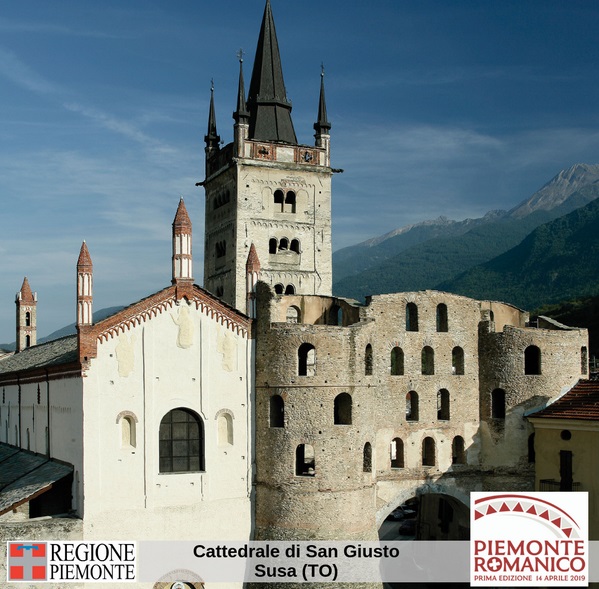
San Giusto di Susa - Romanesque cathedral
Gallery

Charterhouse of Madonna della Losa - Gravere
Charterhouse of Madonna della Losa - Gravere

Sacra di San Michele - Sant'Ambrogio of Turin
Sacra di San Michele - Sant'Ambrogio of Turin

Cloister of the Benedictine Abbey of SS. Pietro and Andrea - Novalesa
Cloister of the Benedictine Abbey of SS. Pietro and Andrea - Novalesa

Church of St. Peter - Avigliana
Church of St. Peter - Avigliana - Isabella Atzori

Crypt of the Parish Church of Santa Maria Assunta - Celle
Crypt of the Parish Church of Santa Maria Assunta - Celle

Church of San Rocco - Condove
Church of San Rocco - Condove

Parish Church of Sant'Antonino Martyr - Sant'Antonino di Susa
Parish Church of Sant'Antonino Martyr - Sant'Antonino di Susa - Edoardo Schiari


You might also be interested in...
- campaign La Pellegrina Legends 4All 2026 celebrates the 1300th anniversary of Novalesa Abbey
- event Heritage meets new forms of expression in Buttigliera Alta
- campaign On October 4th, the walk for the 1300th anniversary of the Novalesa Abbey
- event Rediscovered sacred art in Buttigliera Alta
- event Ab origine in Sant'Ambrogio di Torino
- event Photo exhibition in Villar Focchiardo
- event The Sword of Light in Sant'Ambrogio
- campaign The Free 2026 Guide is now available: 60 pages to discover the treasures of the Susa Valley.
- campaign Novalesa 726-2026, 1300 years since the foundation of the abbey
- book Historic parish churches