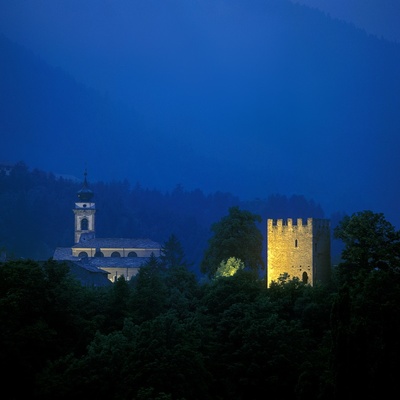
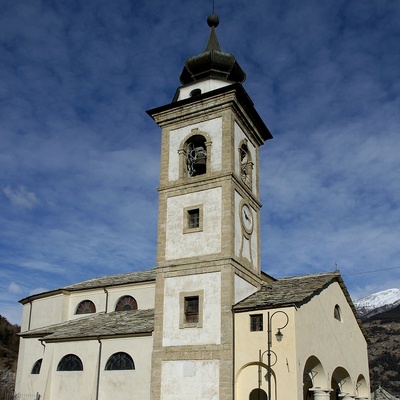
The parish church of Santa Maria Assunta stands on top of a hill, a few steps from the fourteenth-century Delfinale Tower, in the Old Town of Oulx.
The building, mentioned for the first time in a document dating between 1050 and 1061, underwent various alterations over time, the most important of which occurred between the late eighteenth and nineteenth centuries.
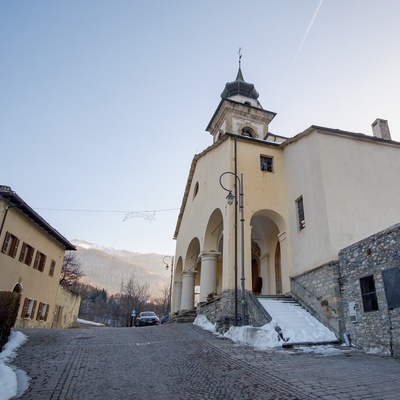
In fact, the demolition of the ancient Romanesque bell tower, which had become unstable, dates back to 1790, of which only a pen drawing remains made by the curate of the time. Most of the original church was demolished and rebuilt in 1861 because the building, due to the instability of the ground on which it was built, was in poor condition. Only the chapel of the Rosary and the entire north side remained intact from the original structure. The main front of the church is externally characterized by a massive portico consisting of three lowered arches, configured as a forward projection from the building.
The main entrance of the church features a stone frame with a round arch and a diamond point decorative motif, embellished with a wooden portal with eight-pointed star reliefs, studs, and rosettes, made by Jacques Jesse of Embrun and his son François in 1676-77. At a later period seems to date the relief placed at the top of the portal, consisting of two angels holding a voluted medallion surmounted by the date 1676, inside of which is painted the coat of arms of Oulx: a turreted shield with a bipartite polylobed cross inscribed. To the right of the entrance portal is a second one, now walled up, characterized by two tuff columns that merge into a round arch, inside of which a keystone depicting the agnus Dei has been placed, almost certainly recovered during the demolition of the old building.
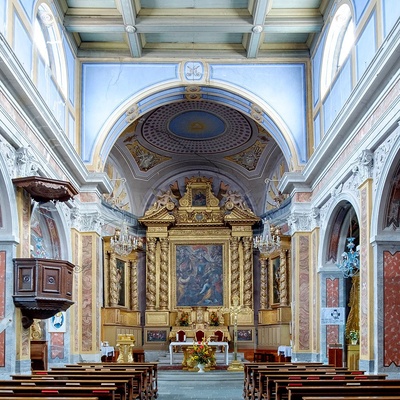
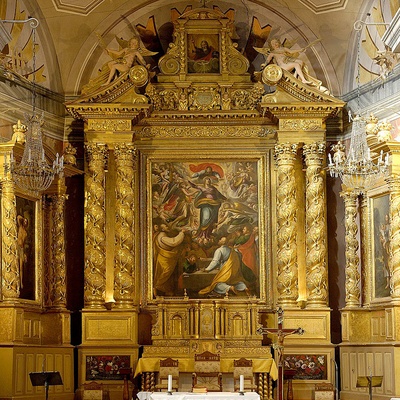
The central nave is covered by a coffered wooden ceiling, while the side aisles have sail vaults. Among the furnishings of particular interest are, besides the already mentioned wooden portal, the tripartite altarpiece of the main altar, another prestigious work of painted and gilded wooden carving made by Jacques Jesse of Embrun between 1670 and 1676 and gilded in 1678 by Peter Milander of Antwerp.
Of notable interest, both for the compositional setup and the ornamentation, are the altars of the Annunciation and the Rosary. The latter in particular features only the carving, without the final gilding.
The building also preserves a significant series of seventeenth-century paintings that testify to the local evolution of late-Mannerist painting, attentive both to models in vogue at the Turin court and just across the border: these range from the Madonna and Child between Saints Francis and Lawrence dated 1630 which would bear the signature of the ducal painter Bernardo Orlando, to the Assumption of the Virgin at the main altar, from 1626, by Mario Zuccari, to the Christ of sorrow between Saints Louis of France and Lawrence, to the already mentioned altarpieces of the Annunciation of the Virgin and the Madonna of the Rosary surrounded by the Mysteries, the latter an autograph work of Orlando.
Contacts