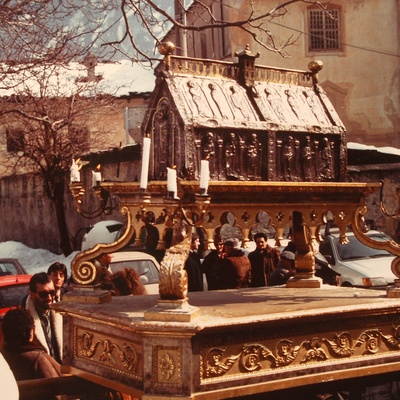
In Novalesa, a procession in honor of the patron saint, Sant'Eldrado, is scheduled for Sunday, March 15. As the calendar indicates, the saint's feast day falls on Friday, March 13, but the procession with the urn containing the saint's relics is scheduled for the holiday. The celebration takes on particular significance on the 1300th anniversary of the founding of the Novalesa Abbey and the 53rd anniversary of the monks' return to the Novalesa monastery, purchased in 1972 by the then Province of Turin, now the Metropolitan City, to save it from architectural and spiritual decay.
The celebrations in honor of Sant'Eldrado will begin on Friday, March 13, at 7:45 a.m. with the celebration of the Eucharist in the abbey church. The subsequent Eucharistic celebration is scheduled for 10 a.m. in the chapel dedicated to the saint. The chapel of Sant'Eldrado will be open to visitors from 9:30 am to 12:00 pm. Vespers will be celebrated in the abbey church at 6:30 pm. On Sunday, March 15, the procession with the urn containing the relics of the Saint will depart from the parish church at 10:15 am and arrive at the abbey church. The Eucharist of the Fourth Sunday of Lent will be presided over by the Abbot Primary of the Order of Saint Benedict, Dom Jeremias Schröder. The civil authorities will be greeted by the Prefectural Commissioner of the Municipality of Novalesa, Michele Pappone. The chapel of Sant'Eldrado will be open to visitors from 10:00 am to 12:30 pm.
Starting Saturday, March 21, guided tours of the Abbey, chapels, and Archaeological Museum will resume, still following the winter schedule: Saturdays at 10:30 and 11:30 a.m., and Sundays at 11:30 a.m. To book a tour, please email visit@abbazianovalesa.org. For further information on tourist and contemplative tours, please visit the Abbey's website at www.abbazianovalesa.org/wp/abbazia-di-novalesa-orari-e-visite/
FURTHER INFORMATION: THE FIGURE OF SAINT ELDRADO IN THE HISTORY OF NOVALESA ABBEY
For the people of the Cenischia Valley and neighboring valleys, the feast of Saint Eldrado is one of the most heartfelt celebrations: it has been handed down and celebrated continuously for over 1,000 years, combining faith and tradition. Saint Eldrado was Provençal by origin and from a noble family. He was abbot of the Abbey of Saints Peter and Andrew of Novalesa in the first half of the 9th century, at the height of Novalesa's history. It is known that he was born in the ancient Province of Narbonne, in an unspecified location watered by the "Dederadus flumen," today's Durance, a left tributary of the Rhone. His date of birth is unknown, and little information has come down to us about the period preceding his arrival in Novalesa. Historiographical sources attribute to him the virtues of austerity, patience, wisdom, nobility of soul and purpose, and magnanimity towards the poor, to whom he distributed much of the considerable wealth inherited from his father. It is said that in his native town he built a church dedicated to Saint Peter and constructed several homes and gardens for pilgrims. He himself went on a pilgrimage through Gaul, Provence, Aquitaine, and Spain, in search of monastic rule, which he finally found in Novalesa, where he stayed as a simple monk for seven years. After the death of Abbot Hugh, whom some believe to be the son of Charlemagne, he himself became abbot, holding the position until his death. He maintained relations with the Frankish rulers, managing to maintain a position of strength against temporal power. He obtained that the Carolingian King and Emperor Lothair, with a diploma dated February 14, 825, granted the Abbey of Novalesa the monastery of Pagno, in the Saluzzo area, as compensation for the assets stolen from it by Louis the Pious upon the foundation of the hospice of Santa Maria on the Mont Cenis Pass. Eldrado died on March 13, likely in 840. Numerous miracles were attributed to him, both during his lifetime and posthumously, such as the liberation of the Briançon valley from the snakes that had infested it, particularly in the village now known as Monêtier-les-Bains. His intercession is also credited with saving a group of crusaders from shipwreck. They had been caught in a storm while returning from the Holy Land and had invoked his help and that of Saint Nicholas of Myra, the patron saint of Bari. The chapel dedicated to him in the Novalicense abbey complex dates, for its oldest part, to the late 9th or early 10th century, while the most recent part dates to the early 11th century. The evocative frescoes from the second half of the 11th century illustrate scenes from the saint's life: Eldrado in the "locus Ambillis" cultivating the family lands; the future Saint dressed as a pilgrim with a staff and a bag, welcomed by a sacerdos; Eldrado arriving at the monastery of Novalesa; Eldrado bending down to put on the monastic habit offered to him by the abbot Amblulfo; the mirac
You might also be interested in...