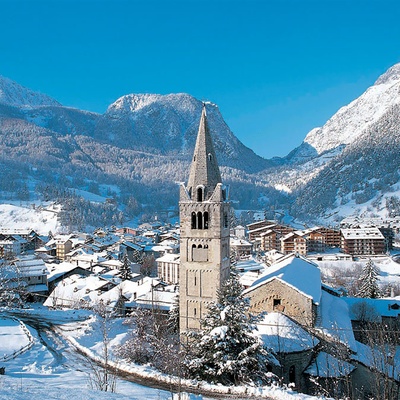
Winter panorama
Winter panorama

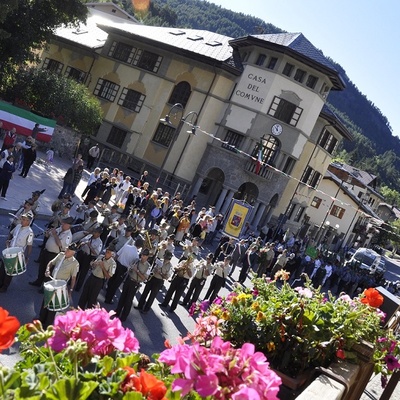
Piazza Vittorio Amedeo, 1, 10054 Cesana Torinese
In the large basin at the confluence of the Ripa and Dora streams and dominated from above by the Chaberton peak (3130 m) and the Monginevro hill, Cesana is remembered by ancient Roman itineraries with the name of Goesao or Gadaone, precisely thanks to the presence of a post station along the route of the Roman road that connected the Po Valley and Gaul through Mons Matronae.
In Cesana, as in the area of the upper Susa Valley, the count family of the Albon was consolidated in the 11th century, who in 1133 took the nickname of Delfini until 1349 when they ceded the territory to the throne of France. Between the 14th and 17th centuries the Cesana valley was the scene of clashes in the religious wars between Catholics and reformed people which culminated in 1574 with the occupation of Cesana by the reformed people of Pragelato. In 1708 during the War of the Spanish Succession Cesana became the scene of battle between the Piedmontese and Savoyard troops and the French army which however managed to penetrate the town causing looting and fires. Cesana also had a castle located on the hill overlooking the village on the right bank of the Ripa, the remains of which can be seen, but it is very likely that the oldest part of the town was also equipped with walls and towers which can still be seen in the current conformations of the houses . In the 19th century, under Napoleonic rule, Cesana and the surrounding area were affected by the improvement of the transit route with the construction of the carriage road which allowed for an improvement in transit even in the winter season.
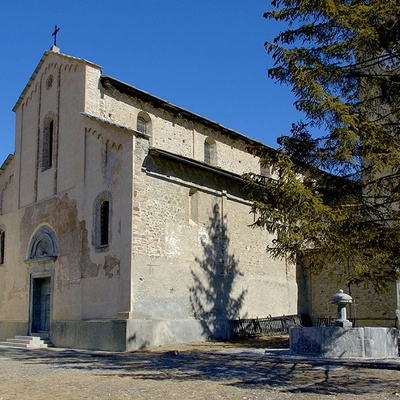
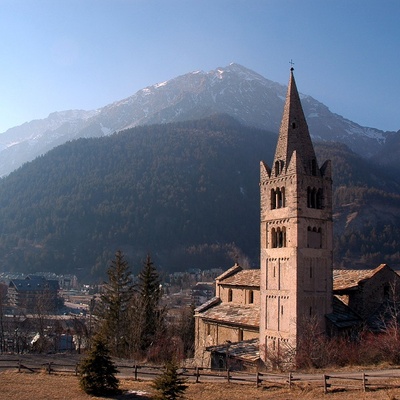
The church of San Giovanni Battista, the oldest in the Cesana valley, remodeled several times over the centuries, has a structure with three naves covered by a valuable wooden ceiling with polychrome molding by the carver Francois Ruas du Pont in 1678 while the tower bell tower in the Romanesque style of the Finale presents a harmonious octagonal spire with acroteria. The territory of Cesana is very vast and includes many hamlets, once equipped with autonomous parishes which still today are among the most significant examples of religious art in the upper valley: Bousson with the parish church of the Madonna della Neve (1505) with the portal in stone by the stonemason Matheus Rode of Melezet, the stone bas-relief of the Visitation and the wooden one of the Madonna of the Black Lake by the Master of Bousson active in the Cesana valley in the eighteenth century; still in Busson among the houses with traditional architecture, the House of Tombstones is one of the archaeological mysteries still unsolved: the tombstones bearing inscriptions in French perhaps linked to the Jansenist movement present artistic decorations that lead back to the style present in this area between the 17th and 19th century and therefore perhaps the building can be traced back to the home of a family of artists in the first period and then of a brotherhood; Thures, in front of the beautiful octagonal fountain, the parish church of Santa Maria Maddalena with the stone baptismal font (15th century), the anthropomorphic capitals and the retable of the main altar by Jean Faure (c.1660); Fenils, parish church of San Giuliano (1490) enlarged during the eighteenth century with typical baroque decorations, has a wooden lacunar ceiling, the retables of the main and side altars; Desertes church of Santa Margherita (1485) from the characteristic portal with wooden rose motif by Jacques Jesse of Embrun (c.1670) from the eighteenth-century wooden retable.
With the advent of winter tourism and the spread of skiing, Cesana has also developed a new residential area, becoming one of the privileged accesses to the Via Lattea ski area also established with the 2006 Winter Olympics.