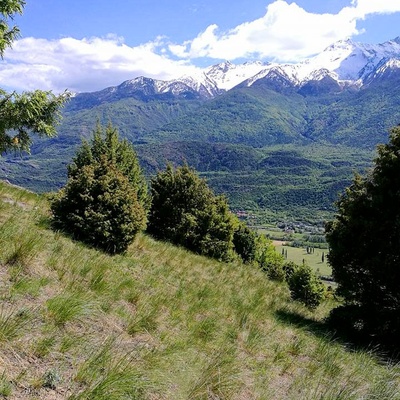
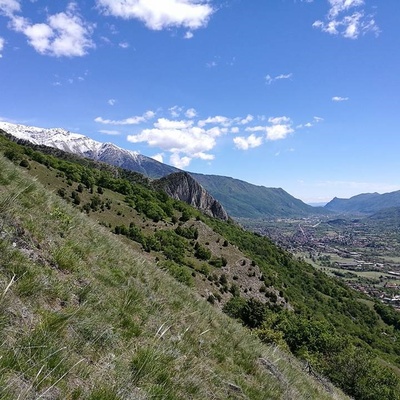
The “Xerothermic Oasis” include the Orridi of Chianocco and Foresto, regional protected areas (Special Nature Reserve of the Orrido and Holm Oak Station of Chianocco, Special Nature Reserve of the Orrido of Foresto and Juniperus oxycedrus Station of Crotte-San Giuliano) and cover an area of 1410 ha on the left side of the central sector of the Susa Valley.
The geomorphology of the area is characterized by limestone walls carved by narrow ravines, called “orridi”, generated by the erosion caused by small tributaries of the Dora Riparia on the powerful limestone layers. Another significant geomorphological element is the extensive moraine deposits left by the glaciers at the end of the last glaciation. These easily erodible deposits are concentrated in the upper part of the Rio Prebec basin and have given rise to badlands and, in localized areas (Margritt, Alpe Pianfé, Alpe Molé), to earth pyramids.
The forest cover is mainly provided by downy oak woods (Quercus pubescens) which are slowly recolonizing the lower slopes, which were occupied by pastures and fields until 30-40 years ago. Common, particularly within the orridi and at higher altitudes, are also beech forests.
Within the SAC “Xerothermic Oases of the Susa Valley - Orrido of Chianocco and Foresto” there are priority habitats “Semi-natural dry grasslands and scrubland facies on calcareous substrates (Festuco-Brometalia) with superb orchid flowering” (Code 6210*) and “Sub-Pannonic steppic grasslands”(Code 6240*). These habitats are particularly valuable for their extent and richness in orchids and rare species, but due to the progressive abandonment of agro-pastoral activities, they are now threatened by the invasion of trees and shrubs and changes in floristic composition. The Life Xerograzing project, launched in 2013 and concluded in 2018, is aimed at the conservation and recovery of xerothermic grasslands in the Susa Valley through pastoral management.
The location of the Susa Valley in the center of the Piedmontese Alpine arc favors particular climatic conditions, characterized by reduced precipitation, less than 800 mm annually; the south-facing exposure of the slope also creates a particularly mild microclimate in winter and very dry in summer, giving Mediterranean characteristics to the vegetation and fauna, hosting many species of Mediterranean or Central Asian origin, linked to hot and dry climates (“xerothermophilous” species), many of which have their only Piedmont stations here or are extremely rare outside the valley. Among the flora, the best-known and most striking examples are the holm oak (Quercus ilex) and the prickly juniper (Juniperus oxycedrus). The holm oak is an evergreen oak typical of the Mediterranean coastal belt: in the Orrido of Chianocco, it has the only certainly spontaneous station in Piedmont. The prickly juniper has its only Piedmont stations in the Orrido of Foresto. Species with a Mediterranean range such as the rare Lavandula angustifolia, Ononis pusilla, Leuzea conifera, Fumana ericoides, and Cheilanthes acrostica are also present.
The faunistic interest is due to the presence of numerous invertebrate species, rare or exclusive at the regional level.
Since March 15, 2019, it has been managed by the Management Authority of the Protected Areas of the Cottian Alps, and it has become a Special Conservation Zone, that is, a site for which the region has prepared the relative Site and Species Specific Conservation Measures and which has been designated as such by ministerial decree, in agreement with the region.