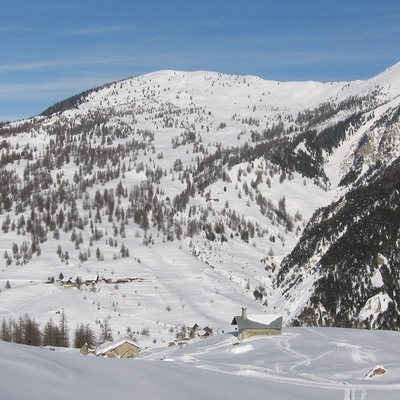
The site covers an area of 981 hectares on the right hydrographic side of the Thuras stream, which from the valley floor, approximately between the village of Rhuilles and the Ciatagnera bridge, reaches the watershed line with the Argentera valley.
The Thuras valley offers opportunities for hydrogeological routes, both for its formation suspended high above the main U-shaped Cesana valley with steep slopes and moraine deposits on the sides, and for the quality of its calcareous substrate, from which one of its priority habitats originates, that of fixed springs with travertine formation and the presence of ferruginous hot springs, evident also for the typical reddish color that some streams assume. There are 2 other priority habitats, among the 12 of the directive, that characterize this site: the formations of Mountain Pine and Arctostaphylos uva-ursi, which develop on screes and detrital deposit areas, and the forest of Hooked Pine on a calcareous substrate.
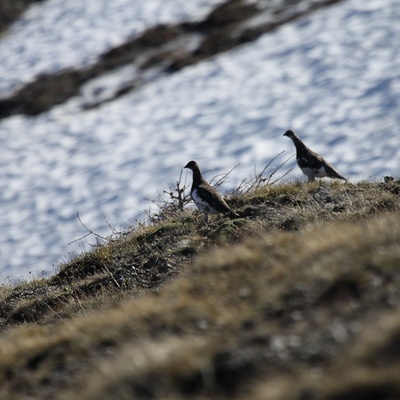
In the valley floor, there are also wet areas near the village of Rhuilles, and riparian vegetation of Salix eleagnos along the Thuras stream. The watershed crest with the Argentera Valley is dominated by the peaks of Monte Furgon, Punta Muta, Monte Gran Roc, Roc del Boucher, and Punta Ciatagnera, all peaks above 3000 meters dominated by rocky habitats of calcareous screes with Thlaspietea rotundifolii and calcareous rock walls with chasmophytic vegetation such as Potentilletalia caulescentis. Over 350 botanical species have been recorded in just under 1000 hectares, including rare endemisms such as Campanula cenisia, Campanula alpestris, Brassica repanda, and Veronica allioni. At the avifaunistic level, over 80 species have been reported, including tetraonids such as the Black Grouse and the Rock Ptarmigan or birds of prey like the Eagle and the Eagle Owl.
In the seventies, this valley, along with the nearby Argentera valley, was to become one of the protected areas of the Piedmont Region to preserve its scenic beauty and floral varieties. Nothing came of it, so today, although classified by the European Union as S.I.C., the environmental risk is always around the corner. Since 2000, some residents and holidaymakers have joined forces to promote knowledge of the area and more conscious winter tourism, dedicated to slow-snow, which are less impactful mountain practices such as cross-country skiing and snowshoeing.
Since March 15, 2019, it has been managed by the Management Body of the Protected Areas of the Cottian Alps and has become a Special Conservation Zone for which the region has prepared the relevant site-specific and species-specific Conservation Measures and which has been designated as such by ministerial decree, in agreement with the region.