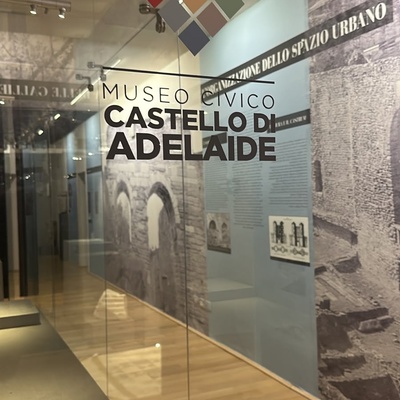
Museum installation
Museum installation
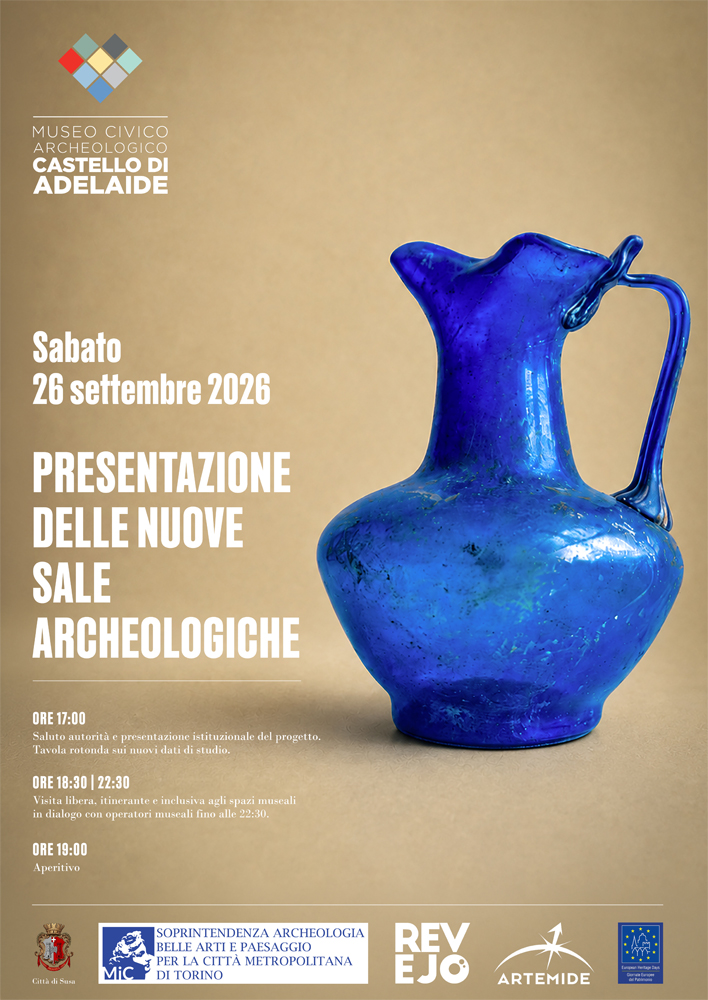
On Saturday, September 26, the Civic Archaeological Museum of the City of Susa opens seven new archaeological galleries to the public. These new spaces complement the ground-floor areas dedicated to the city; designed by the Superintendency for Archaeology, Fine Arts, and Landscape of the Metropolitan City of Turin, they showcase the results of over a century of archaeological research in Susa and its valley.
The first gallery is dedicated to the earliest artifacts from the region, spanning a vast timeframe from the Neolithic to the Iron Age. Highlights include a bronze spearhead from the Malano hamlet in Avigliana—dating to between the mid-14th and early 12th centuries BC—which finds close parallels in the Swiss cantons of Fribourg and Valais, testifying to a network of connections with transalpine communities that existed even then. For this occasion, items on loan from the Royal Museums of Turin are also on display, including fibulae and a particularly significant bronze chain.
The subsequent six galleries recount the birth and evolution of the Roman city of Segusio: the agreement struck between Augustus and King Cottius—an event in 13 BC that gave rise to the Province of the Cottian Alps—and the Arch erected shortly thereafter to commemorate it; the city of Segusio itself, with its forum and major infrastructure projects; official cults alongside deities of local tradition; daily life in private homes (*domus*); and the necropolis areas. Among the exhibited artifacts are two bronze statuettes dating to the 2nd–1st century BC depicting Hercules *Promachos*—the warrior hero shown standing with a club and lion's skin—representing the earliest evidence in the Alpine region of new, Greco-Roman forms of worship. The scientific plan for the archaeological exhibition—drafted by Federico Barello and Luisella Pejrani Baricco with the collaboration of Luisa Ferrero and Sofia Uggé—was further supported by an analysis of the materials conducted by Enrica Calabria, Paola Comba, and Stefania Padovan. The project established the narrative framework for the entire visitor route, basing it on data from archaeological research conducted in the valley since the 1980s. Since then, work has continued in storage facilities and archives, involving the verification and study of materials, restoration, documentary research, graphic design, and the creation of display elements. The rooms opening on September 26th therefore represent the initial realization of that vision.
This achievement was made possible through the continuous, collaborative effort between the Superintendency for Archaeology, Fine Arts and Landscape for the Metropolitan City of Turin and the Municipality of Susa. Technical and scientific coordination was overseen by Deborah Rocchietti, an official from the Superintendency (ABAP-TO), who supported the Adelaide Castle technical-scientific team at every stage. The selection of materials, drafting of texts, conservation decisions, and verification of educational content were developed jointly, engaging various professionals in an interdisciplinary approach aimed at deepening the understanding of the subject matter. New graphic and educational displays accompany the entire route, designed with a focus on readability and accessibility.
The entire process was supported by the Superintendency (ABAP-TO) and the City of Susa, with the collaboration of the Revejo Association and the Artemide Association. The event on Saturday, September 26, begins at 5:00 PM with welcome remarks from officials and a presentation of the project. This is followed by a roundtable discussion on new research findings featuring Federico Barello (Superintendent for Archaeology, Fine Arts, and Landscape for the provinces of Biella, Novara, Verbano-Cusio-Ossola, and Vercelli), Deborah Rocchietti and Luisa Ferrero (Superintendency for Archaeology, Fine Arts, and Landscape for the Metropolitan City of Turin), Elena Cimarosti (University of Genoa), and Maurizio Gomez Serito and Nannina Spanò (Politecnico di Torino). From 6:30 PM to 10:30 PM, the public is invited to explore the rooms freely in an inclusive, self-guided tour while interacting with museum staff; an aperitif reception will take place at 7:00 PM.
For European Heritage Days, the museum will remain open until 10:30 PM. On Sunday, September 27, European Heritage Days continue—alongside the "Archaeology in the Valley" Day organized by *Tesori d’Arte e Cultura Alpina*—with guided tours of archaeological sites at 10:30 AM and 11:30 AM, and visits to Adelaide’s Castle at 3:00 PM and 4:00 PM; all tours depart from the castle.
INFORMATION
Civic Archaeological Museum of the City of Susa – Adelaide’s Castle
Via Impero Romano, 10059 Susa
Tel. 3513078654 - castellosusa@gmail.com
Free admission on Saturday, September 26, and Sunday, September 27. Reservations for Sunday’s guided tours can be made via the museum's phone number or email.
On other days, the museum is open during regular hours and at standard rates (until Sunday, October 4).