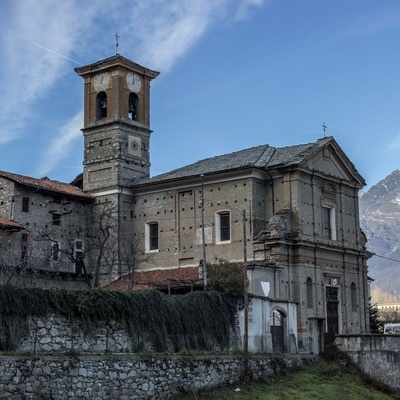
Via Conti Carroccio, 31, 10050 Villar Focchiardo
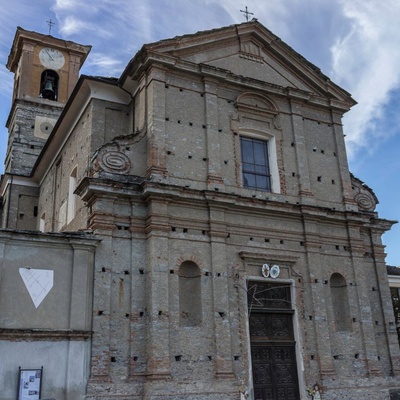
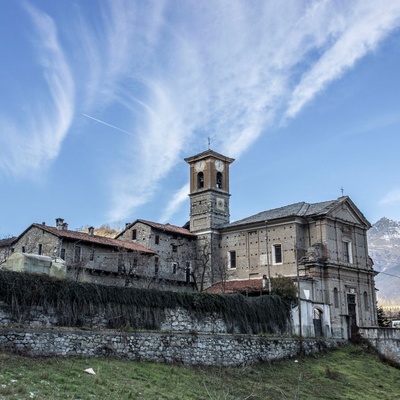
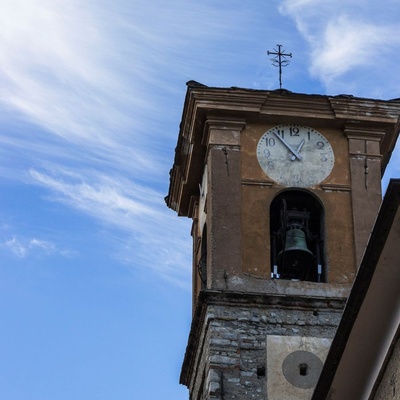
The parish church of Santa Maria Assunta was built between 1717 and 1735 on land located at the top of the town, donated by Abbot Ignazio Carroccio, a member of the local count family and canon of the Turin Cathedral. The new building replaced the old one - of which no trace remains - built in the Villa district and made unusable by a flood of the Gravio torrent on 24 October 1706. The current building has not undergone significant interventions over time, except for the redecoration of the interior took place in 1885. The church overlooks a churchyard which houses a wooden cross erected in 1840 following a popular mission. Both the gabled facade with triangular tympanum and imposing wooden portal and the bell tower present an unfinished appearance, as they were never plastered.
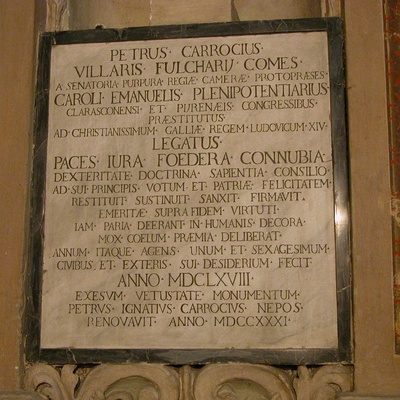
Inside, the building develops according to a single nave layout decorated with a complex entablature, pilasters and capitals, flanked by two side chapels. The structure is also concluded by a semicircular apse, while on the counter-façade there is an imposing balcony choir with a curvilinear wooden parapet, which houses a pipe organ. The entire interior is richly decorated with phytomorphic and geometric motifs, as well as medallions with depictions of biblical scenes. Among the furnishings, noteworthy is the polychrome wooden crucifix from the Certosa di Banda (or more probably from that of Montebenedetto), an expression of the evolution of thirteenth-fourteenth century statuary in the Susa Valley. To celebrate the prestige of the Carroccio family as commissioners of the building, we have the funeral monument of Abbot Ignazio, built in 1668 and renovated in 1731. Among the seventeenth-century paintings, noteworthy are the altarpiece of the Assumption between Saints Cosmas and Damian and that of the Madonna and Child with Saints Dominic and Anthony of Padua, while the eighteenth-century renovation updated on the methods of Milocco can be seen in the altarpiece for the altar of the Souls (the chronological reference term 1717-1735 is valid, coinciding with the renewal of the 'building).