Memorial
Memorial

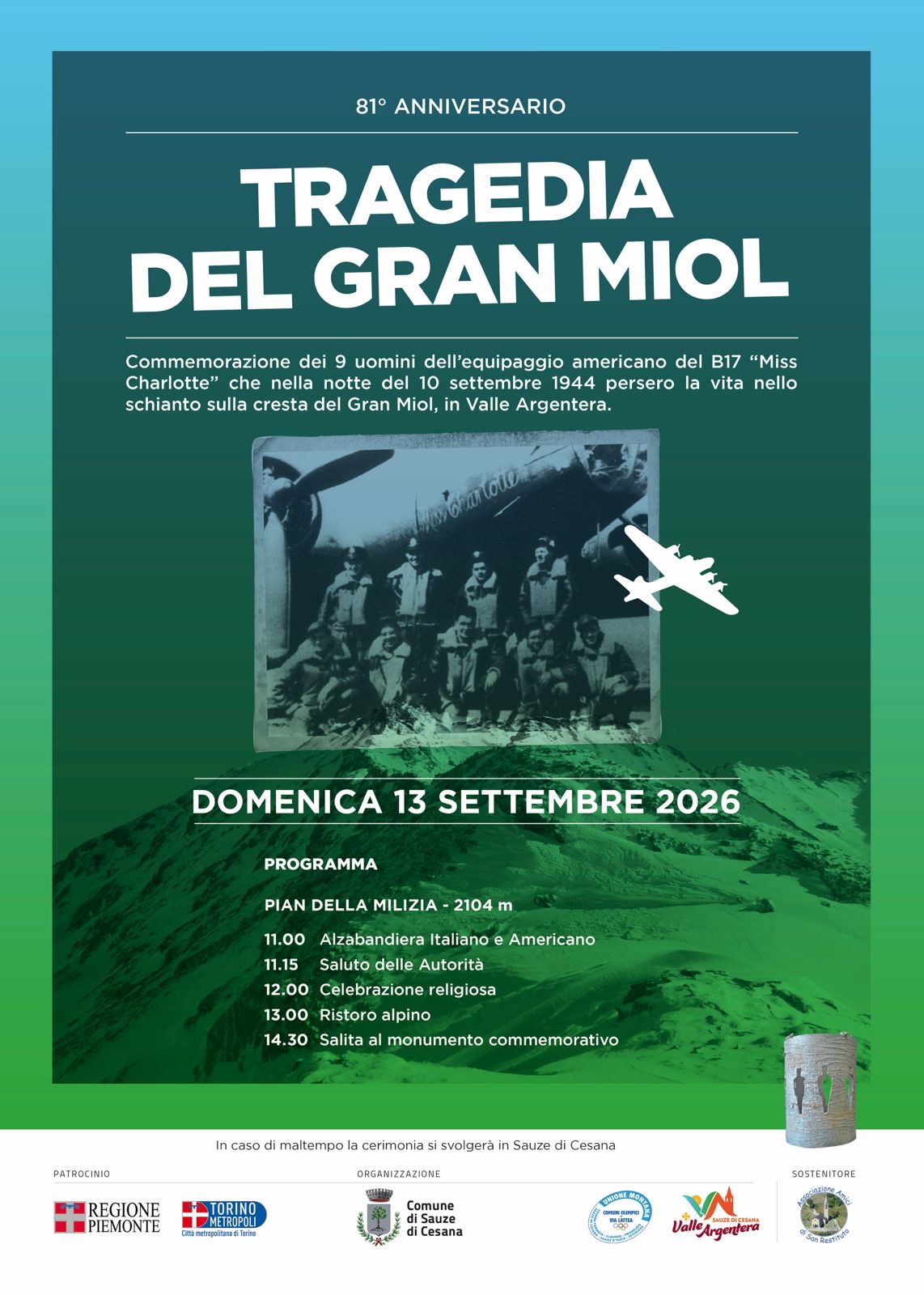
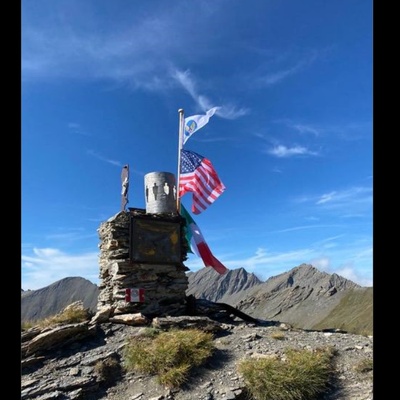
Miss Charlotte is the name of the US military plane that crashed into Gran Mioul on September 10, 1944, in the Sauze di Cesana area of the Argentera Valley, while on a mission to parachute aid for the Cuneo partisans stationed in the Pesio Valley. All nine crew members lost their lives in the terrible accident. The plane, carrying supplies, medicine, weapons, ammunition, and propaganda leaflets, had departed from Algiers and, due to adverse weather conditions, veered off course. The name given to the aircraft, a military Boeing B-17F, was given by the crew commander: Charlotte was the name of his fiancée's mother. 82 years after that tragic event, the Municipality of Sauze di Cesana has not forgotten and wishes to remember the heroic sacrifice of the Miss Charlotte crew, as has been customary for 12 years now, with a commemoration sponsored by the Piedmont Region and the Metropolitan City of Turin: on Sunday, September 13, at 2,104 meters on Pian della Milizia, the celebrations will begin at 11:00 a.m. with the raising of the Italian and American flags and a greeting from the authorities. At 12:00 p.m., a religious rite will be held in memory of the fallen. The program includes an Alpine refreshment stop at 1:00 p.m. and the subsequent ascent to the memorial monument. The crew of Miss Charlotte consisted of nine members: pilot Second Lieutenant John R. Meyers, co-pilot Second Lieutenant Darl J. Heffelbower, navigator Second Lieutenant Ian S. Raeburn, bombardier Second Lieutenant Raymond L. Wilson, radio operator Sergeant Ernest G. Kolln, mechanic Sergeant Donald C. Pullis, machine gunners Corporals Robert B. Lloyd, Louis H. Simpson, and Walter H. Bildstein. On Sunday, September 10, at 7:00 p.m., Miss Charlotte took off from the base of the 885th Special Operations Squadron of the United States Air Force at Maison Blanche, near Algiers, carrying fourteen cylindrical containers containing weapons, ammunition, supplies, and propaganda leaflets destined for the partisan formations stationed in the valleys of the Cuneo Alps. After flying over the Mediterranean, the aircraft skirted a stretch of the southern French coast and, instead of turning north at Cape Mele, turned north-northwest near Menton. Amid a snowstorm with violent gusts of wind, the crew failed to realize they had taken the wrong direction. Despite the poor visibility, the pilot descended the aircraft to locate some landmarks. The B-17 passed over the Frappier Pass, avoided the Gran Queyron and Cima Frappier, entered the Argentera Valley and reached the Sestriere Pass, where the crew realized they were off course. After repeatedly overflying Sestriere, the pilot reversed course to a south-southwesterly direction, leading the aircraft towards the Argentera Valley and the Frappier Pass. Once she avoided the eastern ridge of Punta Ramiere, Miss Charlotte began to climb, but while attempting to enter the Frappier Pass, she crashed into the Grand Mioul.
In 1945, some of the remains of the nine airmen who died in the B-17 explosion were buried in Sauze di Cesana, then transferred to the American Cemetery in Florence, and finally returned to the United States. The final discovery of the B-17's wreckage and the identification of its crash site, however, did not take place until the summer of 1992, thanks to Philippe Castellano, Christian Vigne, and other members of the French association AERO-Recherche, Localisation et Identification de Crashes. During a reconnaissance, engine and weapon parts, fragments of containers carrying aid intended for the partisans, shreds of clothing, parachute flaps, and even human remains were found. Near a large boulder, they spotted a "Mae West," the life jacket aviators are required to wear when flying over seas. Upon examining it, the AERO-Re.L.I.C. men noted initials and parts of a serial number on the collar lining, which allowed them to identify the life jacket: it was the Mae West of John R. Meyers, the pilot of Miss Charlotte.